Palm Springs Is One of the Most Compelling Places to Own Property in America. It's Also One of the Most Complicated.
A complete picture for buyers who are seriously considering the desert.
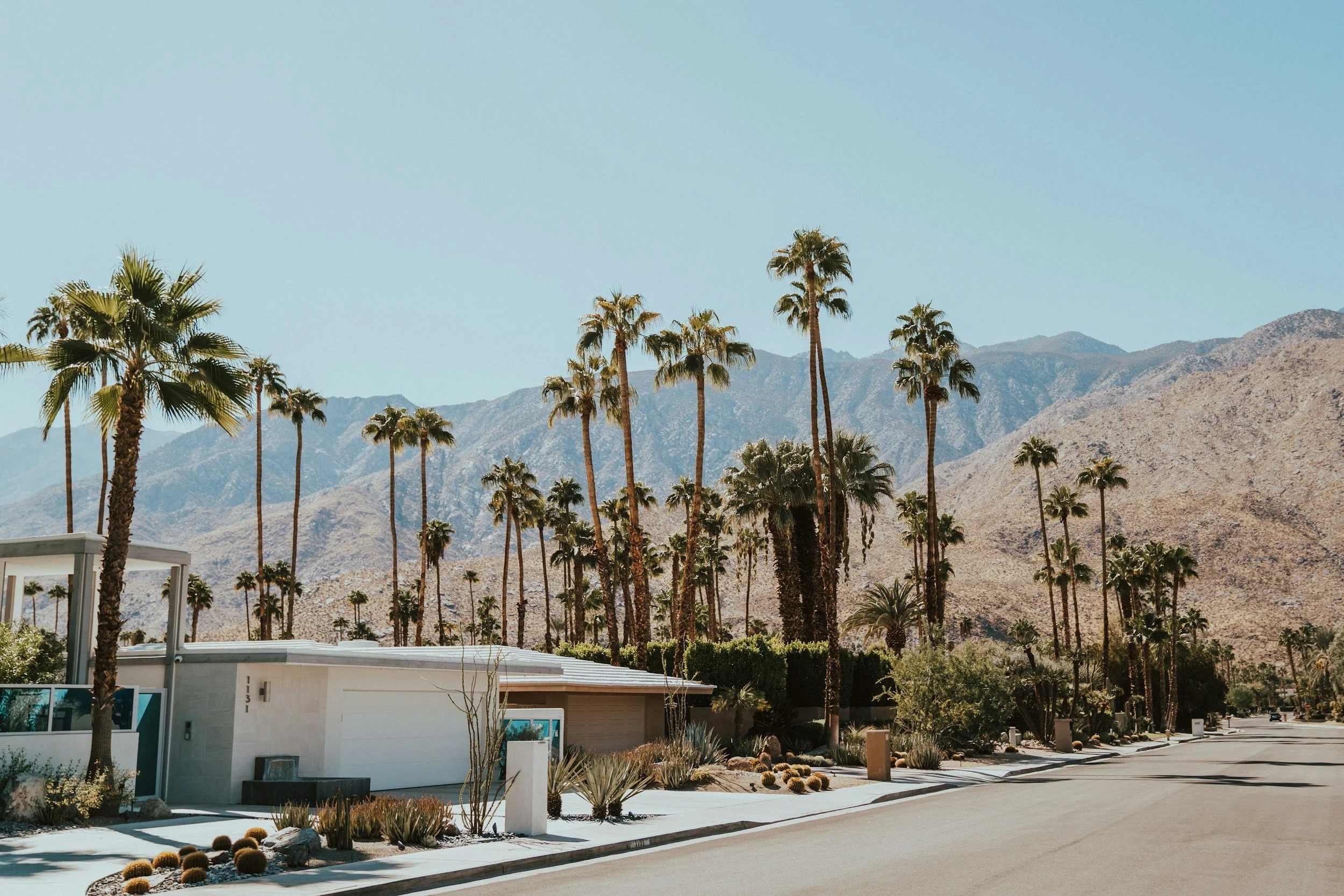
There is a version of Palm Springs that exists in the imagination of almost everyone who has been there. The version with the afternoon light going golden over the San Jacinto Mountains, the pool shimmering behind a wall of bougainvillea, the mid-century rooflines clean against a cloudless sky. It's a powerful image. It's also real — and that's part of what makes this such a complicated city to think about clearly when you're considering whether to own property there.
Because the version in the brochure and the version you'd actually be living in are the same city, which means both are true at once. Palm Springs is genuinely extraordinary. It's also genuinely extreme. The buyers who navigate it best are the ones who can hold both of those things in their head simultaneously — who fall in love with the place without losing sight of what it actually demands.
That's what this piece is for.
The Pull Is Real and It Has a Long History
Before we get to the complications, the case for Palm Springs deserves to be made properly — because it's substantial, and it goes deeper than the aesthetics.
Palm Springs became what it is over a century of accumulated meaning. The Agua Caliente Band of Cahuilla Indians inhabited this desert long before the city existed; their tribal lands constitute roughly 18% of what is now the city, and their stewardship of this land is woven into its identity in ways that remain visible today. The modern city began to take shape in the early twentieth century as a health destination — the dry desert air thought to be therapeutic — and by the 1920s and 30s it had become a retreat for wealthy Angelenos looking to disappear from public life.
Hollywood came and changed everything. The studio system at its height exerted suffocating control over performers' public identities, and Palm Springs, just two hours from Los Angeles but entirely outside the reach of the studio fixers, became a kind of safety valve. Stars came here to be themselves. And because being oneself, in that era, often meant being queer in a world that didn't tolerate it, Palm Springs gradually became a refuge for the LGBTQ+ community in a way that shaped its character permanently.
Rock Hudson watered his lawn in tiny short-shorts, waving cheerfully at the celebrity home tour buses as they rolled past. Liberace lived here for 25 years, hosting lavish parties at a compound that reflected every flamboyant dimension of his personality, at a time when that kind of visibility required considerable courage. The architects who gave the city its visual identity — many of them gay men in an era when that fact required careful management — built homes that expressed freedom and openness, glass walls dissolving the line between interior and exterior, indoor spaces flowing into pools and gardens and the vast desert sky.
That legacy didn't dissipate. It deepened. Today it's estimated that roughly half of all Palm Springs residents over the age of 55 identify as LGBTQ+, making it one of the most genuinely queer cities in the United States by population share, not just by reputation. Nearly 40% of the city's total population identifies as LGBTQ+, and the city has formalized what was once informal: Palm Springs has declared itself a sanctuary for drag performers, a political statement aimed squarely at the wave of state-level restrictions spreading across other parts of the country. In February 2025, residents transformed the Arenas District into a scene of fierce resistance and LGBTQ+ activism, with chants of "Love is Love" and "We're not going back" ringing through the crowd. Palm Springs is not a place that tolerates queer life. It was built around it.
For buyers who are part of the LGBTQ+ community, or who simply want to live somewhere that reflects the values of inclusion and visibility, that history isn't just atmosphere. It's infrastructure. It's community organizations, healthcare providers, cultural institutions, and a civic government that has repeatedly chosen to protect and celebrate its LGBTQ+ residents when states elsewhere have moved in the opposite direction.
What the City Has Become
The Palm Springs of today has layered something new and genuinely exciting on top of that historical foundation.
The culinary scene has arrived. James Beard Award-winning chefs Susan Feniger and Mary Sue Milliken opened Alice B, their latest venture, inside Living Out — a luxury retirement community for LGBTQ+ residents that opened in 2023. It is, as one writer put it, not often that you find the hottest new restaurant in town hidden inside a retirement community. But that's the kind of delightful surprise that defines contemporary Palm Springs. The Arenas District, long the heart of the city's LGBTQ+ nightlife, has evolved and expanded. The Uptown Design District has become a serious destination for design-forward retail and dining. And the cultural calendar — Modernism Week in February, the Palm Springs International Film Festival in January, Cinema Diverse in September — has given the city a year-round identity that goes far beyond the pool-and-spa reputation it once leaned on.
The remote work era accelerated something that had been building for years: the arrival of younger, high-earning buyers who don't need to live near a corporate headquarters and who are choosing cities based on quality of life rather than proximity to an office. Palm Springs caught that wave early. The demographic influx from San Francisco, Boston, and Seattle — buyers bringing coastal equity and coastal sophistication into a desert market — has changed what the restaurants serve, what the galleries show, and what the new development looks like. The city's own economic development strategic plan identifies the growth of a local technology ecosystem and the leveraging of remote work trends as key opportunities for the next decade of Palm Springs' development.
All of which is to say: the city is not standing still. The version of Palm Springs you buy into today will be a different and likely more developed version of itself in ten years. That's a meaningful consideration for buyers thinking about long-term value, not just present-day livability.
The Part Nobody Puts in the Brochure
Here is where the honest conversation begins.
Palm Springs is a desert. Not in the romantic, abstract sense — in the literal, thermometer-reading sense. In a typical year around 1990, people in Palm Springs experienced about 7 days above 110°F annually. By 2050, that number is projected to reach an average of 32 days per year above 110°F. Let that sink in for a moment. We are talking about a city where, within the lifetimes of people buying property there today, more than a month of every year will be spent at temperatures that are not merely uncomfortable but genuinely dangerous for extended outdoor exposure.
A climate analysis commissioned by the city found that the number of extreme heat days — defined as days above the threshold at which heat becomes a public health risk — is projected to increase to an average of 28 per year by mid-century, and an average of 50 per year by the end of the century. Fifty days. Nearly two months of every calendar year at temperatures that will keep you indoors, keep your pets inside, and require genuine planning around any outdoor activity.
A long-term Palm Springs resident, speaking to this reality online, put it with the kind of unvarnished clarity that only comes from lived experience: "I've lived here for over 20 years and I honestly believe this place is so hot in the summer that it should be uninhabitable. You NEVER 'get used' to summers, you just learn to live with them. It's ridiculous to walk outside at 10 or 11 pm and be sweating within minutes."
This is not a fringe perspective. It is what year-round residents say when they're being honest.
Now, it's worth noting that a significant portion of Palm Springs buyers are not year-round residents. They're second-home buyers who intend to be in Palm Springs during the fall, winter, and spring — the months when the city is legitimately paradise — and somewhere else entirely during July and August. For those buyers, the heat reality is a manageable consideration, not a dealbreaker. But it is still a consideration that shapes property costs, maintenance realities, and the carrying costs of ownership in ways that deserve careful thought.
The intense heat means higher electricity bills due to constant air conditioning use, which is not a minor line item in a desert property budget. Air conditioning systems in Palm Springs work harder and fail faster than they do in more temperate climates. Pools require more chemical treatment in extreme heat. Landscaping choices are constrained by water availability and temperature. The exterior materials on mid-century homes — many of them architecturally significant and thus difficult or impossible to replace without compromising historical character — deteriorate faster in sustained extreme heat.
And then there's the insurance picture, which has changed dramatically in recent years and which buyers cannot afford to ignore.
---
The Insurance Crisis Is a California Story That Reaches the Desert
California's homeowner insurance market is in the middle of a genuine crisis, and while the headlines have focused on wildfire-devastated communities in Los Angeles and Northern California, the effects ripple across the state — including into the Coachella Valley.
Between 2015 and 2023, there was a 19% reduction in the number of home insurance policies in the highest-risk wildfire areas of California. Since 2019, the number of policies in the highest-risk areas has dropped dramatically, with some of this reduction due to insurers issuing non-renewals — simply declining to renew a policy. State Farm, Allstate, and Farmers have all either paused new policies or exited portions of the California market in recent years, citing wildfire risk and regulatory restrictions that prevented adequate rate increases.
For Palm Springs specifically, about 67% of buildings in Palm Springs are at risk of wildfire, and the risk level for these buildings is classified as very high. About 73% of buildings in Palm Springs are at risk of flooding, and the risk level for these buildings is high. These are striking numbers for a city most buyers associate primarily with sun and pool decks, and they have real implications for what insurance coverage looks like and what it costs.
Several major insurers have paused new policies or non-renewed existing ones in higher-risk regions because of wildfire, inflation, and reinsurance costs. New regulations now allow insurers to use forward-looking catastrophe models in rate-setting for the first time — a major shift that lets insurers pass more reinsurance cost into premiums. When reinsurers look at Southern California, they see wildfire, flood, and mudslide exposures stacked on top of very high property values.
What this means practically for a buyer in Palm Springs is this: before you fall in love with a property and certainly before you make an offer, you need to understand what insurance will actually cost on that specific address, what it covers, and whether standard carriers are willing to write it. Some properties in higher-risk zones will require surplus lines coverage — non-admitted carriers not subject to the same rate regulations as standard insurers, meaning they can price risk aggressively. The California FAIR Plan, the state's insurer of last resort, is an option when nothing else is available, but it is not designed to be a long-term solution, and its financial stability has come under scrutiny as enrollment has surged statewide.
A good local agent will help you navigate this before you're under contract, not after. This is one of the areas where the difference between a specialist and a generalist is most consequential.
The City Is Paying Attention
None of this is to suggest Palm Springs is sleepwalking toward an existential crisis. The city's leadership has been unusually proactive about confronting these realities.
The Palm Springs City Council unanimously adopted a comprehensive 2025-2026 legislative platform covering climate resilience, housing, economic development, and infrastructure. Climate and sustainability goals include expanding electric vehicle infrastructure, reducing utility costs, and advancing air quality and waste reduction initiatives. The city's economic development strategic plan explicitly identifies climate change impacts on water and heat as significant threats, while also naming climate innovation as a key opportunity — with a stated goal of developing cooling and green energy solutions as part of resilient infrastructure investment.
The city has long held a commitment to renewable energy and water efficiency that predates most municipalities' awareness of these issues. Palm Springs has set goals to be a high-efficiency, renewable energy city, and positions itself as a leader in water efficiency and reuse. For buyers, this civic orientation matters: a city government that takes climate risk seriously tends to make infrastructure investments that protect long-term property values more effectively than one that doesn't.
The question is not whether Palm Springs is responding. It is whether the pace and scale of that response can keep up with the rate of change. That's a question no one can answer with certainty, and pretending otherwise would be doing you a disservice.
What a Serious Buyer Needs to Know Before Looking
Pull all of this together and a picture emerges — not of a market to avoid, but of a market that requires informed entry.
The lifestyle case is genuine and durable. The culture, the community, the architecture, the quality of life during nine months of the year, the LGBTQ+ foundation, the food and arts scene, the proximity to Joshua Tree and the San Jacinto Mountains — these are real and they compound over time as the city continues to evolve. People who buy in Palm Springs with their eyes open tend to love it.
The climate reality is not a footnote. It is a primary variable in how you use the property, what it costs to maintain, how you insure it, and what the long-term ownership picture looks like. Understanding this before you buy — not as a reason not to buy, but as context for what you're buying — is the difference between a decision made well and one made on the basis of a photograph.
The insurance market requires specific investigation. Not general awareness — specific investigation. Before you make an offer on any property in Palm Springs, you want to know what insurance will cost at that address, who will write it, and what it covers. This is not something to figure out after you're in contract.
The right agent is a non-negotiable. Palm Springs has a large and active real estate community, but the depth of local knowledge varies enormously. You want an agent who understands the STR permit landscape (as we covered in a separate piece), the insurance environment, the neighborhood-level distinctions, and the city's planning direction. These are not things you can approximate from outside the market.
This is exactly the kind of matchmaking I do — not finding you any agent, but finding you the specific person who knows what they need to know to protect your interests in a market this layered.
A Final Thought
There is a particular kind of buyer who does extraordinarily well in Palm Springs. They came, felt the pull, and instead of either dismissing the complications or pretending they don't exist, they got serious about understanding them. They bought with clarity instead of hope. They found an agent who knew the terrain. And then they spent their winters in one of the most singular places in the United States, having made a decision they're still glad about years later.
That's the outcome this piece is meant to help you achieve — if Palm Springs is right for you.
If you want to talk through what you're considering and whether I can connect you with the right local expert before you start looking, reach out. That conversation is what I'm here for.
John Voirol | John’s Agents | Find My Agent
John Voirol is a licensed real estate professional with 10 years of experience and over $100 million in career sales. He specializes in connecting buyers and sellers with the right agent in markets across the country.
SOURCES
- National Geographic: "Why Palm Springs is America's Greatest LGBTQ+ City Break," 2025
- ClimateCheck: Palm Springs Climate Change Risks and Hazards
- The Palm Springs Post: "Report Details What Climate Change May Mean for Palm Springs," November 2023
- City of Palm Springs: Economic Development Strategic Plan Framework
- Visit Palm Springs: Sustainability & Stewardship
- Deep Sky Climate: "Insurers Retreat as 2025 Wildfire Risk Reaches Dangerous Levels"
- Inszone Insurance: "2026 Home Insurance Rates: Will SoCal's Record-Wet Months Push Them Higher?"
- Quora: "Has the Heat Now Become Unbearable in Palm Springs for Year-Round Living?"]